
Manifesto · Monochronicle
A Better Future for Public Art
Is Already Possible
Imagine a public art ecosystem where artists understand the budget, the site, and the call's expectations before investing days of work in a proposal. Communities shape commissions rather than receive them. The selection process is as thoughtful as the art it produces. Where a mural in a changing neighborhood is grounded in that neighborhood’s history and “we’ll have to wait and see” is replaced by long-term stewardship, honest documentation, and a genuine commitment to what a place might become. That future is not utopian. It is available right now to any program willing to design for it. The P Framework emerged from hundreds of interviews and is the foundation of how we design every open call. It reflects how we work with artists, organizations, and communities. This is our why.
Feel free to share it with colleagues. The field moves forward when more programs work from a common standard.
01 — Place
Every Great Commission Begins With Honest Research
Place is cultural memory. The most durable public art shares one quality: it could not exist anywhere else. It knows its ground, the history layered into it, the community that has lived on it, the meanings a site carries. That knowledge comes from deliberate research, undertaken before an open call is written, before an artist is invited, before a single concept is imagined.
When Place is researched rather than assumed, something shifts. Artists make bolder proposals because they understand what they are responding to. Communities trust the process more because someone clearly listened first. The work that emerges has a specificity that resonates for decades rather than fading into civic furniture within years.
“Many times they don’t give enough information on the walls or the space, no images or exact dimensions to create a proposal.”
— From an artist interview
We build site research into every phase of our commissioning process. Not as a formality. As the foundation on which everything else is built.
02 — People & Purpose
The Future of Public Art Is Made With Communities
Communities shape commissions when they are present at the beginning and included in the process, rather than thanked at the ribbon cutting. The art changes. The community’s relationship to that art changes. The longevity of both the work and the program changes.
Purpose defines the role art is meant to play in a place to heal, activate, commemorate, educate, or transform. When purpose is defined early, artists respond thoughtfully rather than guessing at institutional intentions. Every structural decision in a commissioning process is a statement about whose voices actually matter. What an artist is asked in their application, how the community is consulted, and what the committee is instructed to evaluate are the real instruments of purpose.
“It is important to get it right, not just for the good of the individual project, but for the arts program as a whole. Seeing a project fail in this way will have a community resist future spending on the arts because it will be seen as a waste.”
— From an artist interview
We design our open calls to make people and purpose structural. We treat them that way.
03 — Process
A Fair, Transparent Process Is What Makes the Best Art Possible
The selection process is the first artistic decision a program makes. When it is clear, targeted, and genuinely designed for the artists, better artists apply and bolder ideas are submitted.
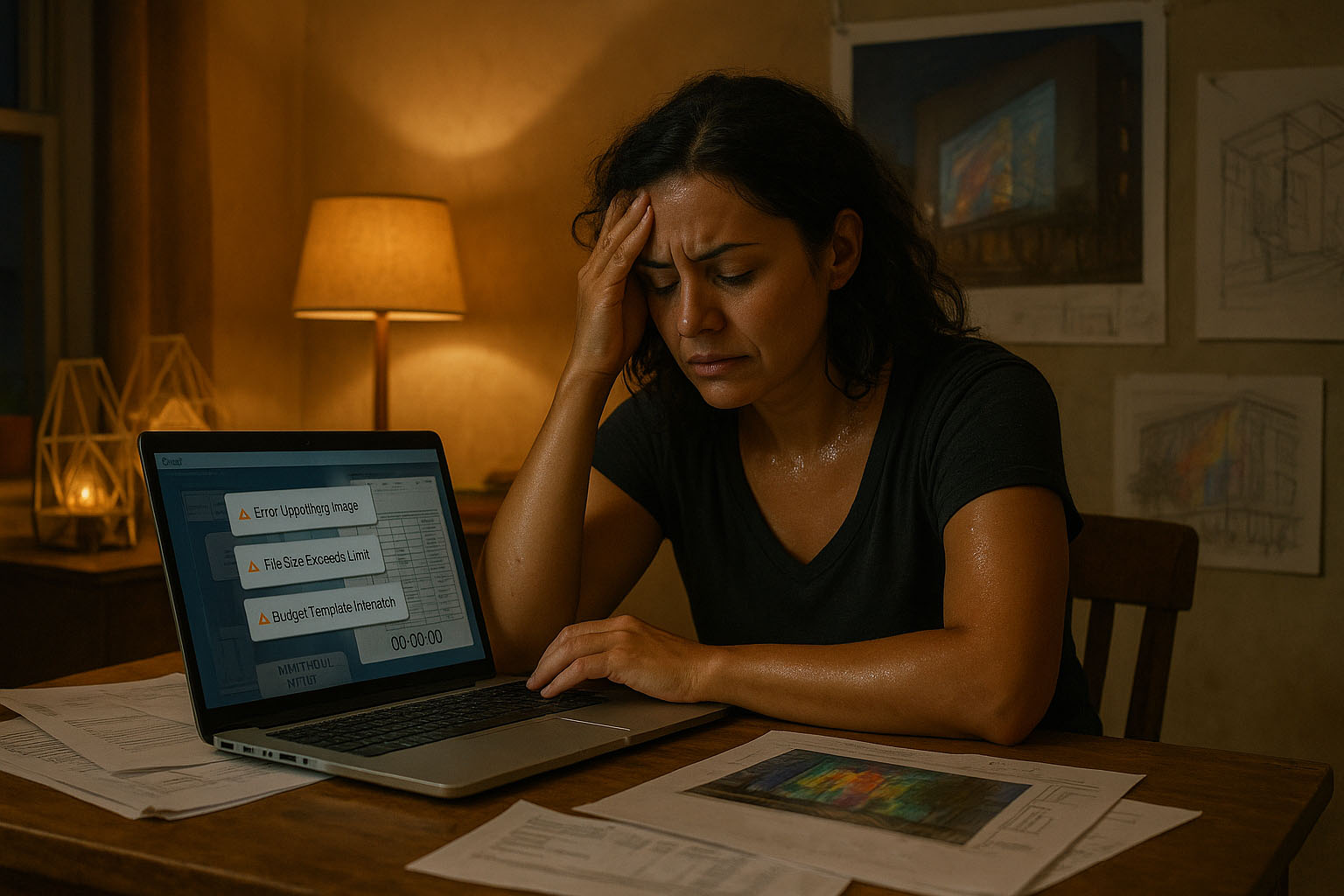
When portals crash on deadline day, when criteria arrive too late to act on, artists respond by submitting the same proposal across a dozen open calls and hoping something lands. The program that earns a considered, site-specific response is the one that made its intentions clear from the start. A well-designed first round asks only for images and a brief statement. Artists should invest proposal-level labor only after eligibility is confirmed.
“They make you repeat the information over and over again for each application. On the description they ask for 10 things, but then the form doesn’t give you space to add those 10 things. Creating the itemized image list and cover letter is the most time consuming.”
— From an artist interview
Our application system is built on a simple idea: procurement should never override creativity. Artists should know the budget before they invest in a proposal. Criteria should be published before creative labor begins. Feedback should be real and specific. The process should be as good as the art it is trying to produce.
04 — Product & Planet
The Best Public Art Makes the World More Beautiful
The product in public art is the artwork itself or the experience it generates. Product design means selecting the appropriate format for the defined goal: permanent versus temporary, object versus event, contemplative versus interactive. Calls that default to “anything goes, all media welcome” generate structural inequity. Selection panels find themselves evaluating proposals that cannot be fairly compared. Define typological parameters before the call opens.
Artworks that choose materials thoughtfully, consider their ecological footprint as part of their design, and ask what happens in fifty years rather than just opening day earn a different kind of trust from the communities they serve. Programs that ask material and ecological questions before the brief is written produce work that endures.
“Most committees focus entirely on design and think that the application is secondary. Meaning, they are not focused on the products or methods used to paint the wall. People don’t realize that if the wrong products or methods are used, the paint could fail off of the wall, fade early, or even damage the wall surface.”
— From an artist interview
We encourage every commissioner we work with to ask material and ecological questions before the brief goes out, not because sustainability is a branding requirement, but because it is an artistic one.
05 — Price
Transparent, Fair Budgets Produce Better Art and Better Relationships
When artists know the budget, they respond with better-calibrated, more ambitious proposals. A total project budget of $2M means little to an artist who cannot determine what portion is allocated to their fee and fabrication. Without that breakdown, accurate proposals are impossible. When shortlisted artists are compensated for their concept work, the artists who actually matter to a community are willing to invest. When fee structures treat artistic labor as professional compensation rather than a civic donation, the relationship between artists and institutions becomes more honest and more sustainable.
“Calls that ask for artwork up front without payment rob the arts community of hours and hours in unpaid labor. Sometimes they say the budget but don’t give you a range for the mural or sculpture section. The other very annoying thing is that sometimes they say the budget, but they don’t actually have the money and they don’t let you know that there has to be a big long process of them applying to grants.”
— From an artist interview
Our position is straightforward: budgets are published, always. Artist fees are calculated as professional compensation, not extracted as a voluntary contribution.
06 — Production
The Work Has to Actually Get Made
Production is the variable that most consistently exposes the gap between expectations and reality. The feasibility conversation must happen before the brief goes out, a contract is signed, a community has been promised something specific, or an artist has invested months in a concept that turns out to be unbuildable within the stated budget.
Production encompasses everything between selection and installation: material sourcing, fabrication, structural engineering, permitting, site preparation, installation logistics, and the long-term maintenance plan that determines whether the work still looks intentional in fifteen years. Programs that build production thinking into the brief, the budget, and the selection criteria produce work that endures.
“I didn’t account for price volatility, the real cost of revision requests, or the lack of change orders in the procurement contract. I delivered the work, but the project was a financial wash.”
— From an artist interview
Monochronicle helps bring projects to life and sustain them over time by coordinating production and maintenance through trusted partners or in-house expertise.
07 — Promotion
An Undocumented Commission Has Never Fully Happened
The public cannot engage with work they do not know exists. They cannot understand thinking that was never explained. A program cannot be held accountable for outcomes that were never documented. Promotion is how a program makes its work legible to the community it serves, the artists it wants to attract, and the field it is part of.
An open call published only on a program website is a call most eligible artists will never see. Artists actively seeking opportunities describe following thousands of social accounts, scanning hashtags daily, and finding calls through luck as much as research. Distribution is a design decision, and it belongs in the brief. Artists gain professional exposure in proportion to how well the commissioning program promotes the work and the people who made it. Administrators who document their processes build institutional memory that survives staff transitions.
“These calls are often not well publicized.”
— From an artist interview
We treat documentation as a core deliverable. Open call promotion, community surveys, vote summaries, and public reports make the process visible and accountable.
08 — Planning
Cultural Master Plans: Strategy Before Selection
A cultural master plan is a framework that makes creative possibilities legible to the institutions that need to fund and approve them. It answers the question every funder, city council member, and skeptical neighbor is actually asking: Why this? Why here? Why now? Why does it matter? Planning converts intention into system. Public art master plans, enabling ordinances, maintenance policies, and project pipelines collectively govern the conditions under which artists work and communities receive art.
Programs that begin with strategy produce more coherent collections, resonant individual commissions, and durable relationships with the communities they serve. Strategy before selection. Vision before procurement.
“Many public art programs are run by professionals who have never done any research into how to run a program.”
— From an artist interview
We help organizations build planning frameworks and master plans before they open calls.
09 — Pace
The Right Pace Creates the Conditions for the Right Art
The name Monochronicle carries two words: monochronic - a precious view toward time, and chronicle - a record of what happened. How a program manages time is one of the most consequential decisions it makes, and one of the least discussed.
When external pressure from developers or institutional stakeholders compresses a timeline, the most protective response is a well-designed first round. Images and a brief statement only, ask nothing more until eligibility is confirmed. Timelines that give communities genuine space to engage produce different commissions than timelines rushed to a ribbon cutting. Artists who have adequate time to research a site, develop a concept honestly, and refine their approach make different proposals than artists working under crisis pressure.
“Everyone wants you to be done, yesterday, and good art can’t be rushed.”
— Public artist
We deliver truly custom solutions for each place and community, one at a time.
10 — Prosperity
The Greatest Public Art Creates Value
The Eiffel Tower was called “useless and monstrous” by three hundred prominent artists and intellectuals before it opened. The Vietnam Veterans Memorial was called “a black gash of shame.” Cloud Gate was a punchline before it became a pilgrimage site. The pattern is consistent. The public art that most profoundly transforms a place is rarely the art that generated the most enthusiasm at selection.
Civic, cultural, and economic prosperity from public art is deferred. It accumulates over years, often in directions no committee could have predicted, in communities that had no voice in the original commission. Programs that understand this commission more courageously, evaluate more honestly, and invest in the long-term care of what they build.
“Prosperity is the compound output, the integrated measure of whether a public art program has meaningfully served the communities, ecologies, and cultural systems it was designed to enrich.”
— Iryna Kanishcheva, Founder, Monochronicle
Prosperity, as we use it, is not a variable to be optimized. It is the compound evidence that Place, People, Purpose, Process, Product, Price, Production, Promotion, Planning, and Pace were all taken seriously. It is what a program leaves behind when it does everything else right.
The P Framework is designed to help you build a system, one open call at a time. When you're ready to put it into practice, Monochronicle's open call platform is structured around each of these principles, giving administrators a place to design, publish, and manage calls that reflect this standard of care.

0 Comments
No comments yet.