
Abstract
In this exploratory text, the authors review different ways in which Blockchain technology intersects with Artificial Intelligence (AI), and with art, and how it connects to a more and more frequently mentioned area such as contemporary art industries. These intersections are pointing at the two aspects worth exploring – the first one is a way in which technology (here Blockchain and AI) can be used in various fields and industries, and the other one follows art as it opens its world to the new technological possibilities, enriching its forms, topics, and manifestations, and questioning the status of the author as well. The art examples and case studies exhibited here will illustrate a couple of problems that can be solved and/or improved with Blockchain and AI technology. These include transparency, art data authenticity, art data monetization, smart contracts with artists, investment opportunities of NFT (non-fungible tokens), roles and activities of curators, psychology of aesthetics, and exploration of creativity.
Blockchain, Artificial Intelligence and Art: Intersections and Reasons
Where are we, where do we want to be, how do we get there? To answer these questions we need data. Relevant, authentic, diversified, and secure. It has been the case in different times, and different societies applied or developed different technologies to ensure the easiest, quickest, and most efficient way to transfer data securely and safely. As for the technology in art, the times of doubt and the times of enthusiasm were interchangeably replaced with each other, producing rather negative or positive attitudes towards the technological world (Adorno & Horkheimer 2002 with McLuhan 1964 or Haraway 1991). However, the fascination with technology, as well as merging contemporary technology with art stayed the same. What artists and the field of art can do is to offer a space and places for pure exploration of human creative potential, and of how technology is used in creative acts and, subsequently, in creative industries. Technology, thus, has never been separate from art, and it has never been a "foreign body" to it. Even when technology is primarily emerging for other purposes than art, and even when it seems questionably useful or problematic to the world of art, the artists sought to In the words of Ruth Catlow, "They [the artists] know that a way to get to know something that doesn’t yet exist is to collaborate with its possibilities and to do something/anything with it or about it. And by doing so they materialize and shape what it will be"(Catlow 2017, 22). Back in contemporary times, it seems that technologies emerge faster and faster, and the two hottest technologies today, Blockchain and Artificial Intelligence (AI) can be effectively combined to use data in ways never before thought possible, not only in the arts but many other industries. Data is the key ingredient for the development and enhancement of AI algorithms, and blockchain secures this data, allows for audit and conclusions from the data by AI, and monetizes the produced data. By definition, a blockchain is a distributed, decentralized, immutable ledger used to store encrypted data. On the other hand, AI is the engine or the “brain” that will enable analytics and decision-making from the data collected, trace, and determine why decisions were made in a particular way. Blockchain and its ledger can record all data and variables that go through a decision made under machine learning, which makes it particularly useful to the field of arts. In this way, we can stress the importance of Blockchain technology in matters of transparency, data authenticity, data monetization, creating smart contracts with artists, investment opportunities of NFTs (non-fungible tokens), and also in changing roles and activities of curators. Blockchain influences the psychology of aesthetics and creates an open field for the exploration of creativity. Adding AI into these intersections of Blockchain and art has already produced some impressive results (Suvajdžić et al. 2019), in the next chapters we will explore already mentioned areas, as well as some of the art projects where Blockchain and AI collide.
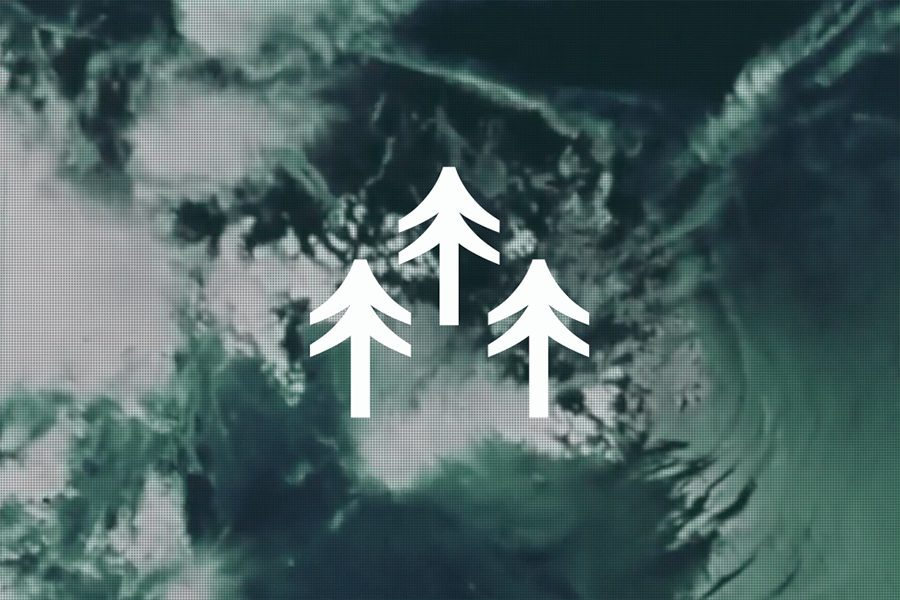
terra0 is an evolving prototype built on the Ethereum network that aims to provide automated ecosystem resilience frameworks. Courtesy terra0.org
Blockchain Technology, AI and its Usage in Art: Benefits and Innovations
Transparency
The Freedom of Information Act (FOIA) has provided the public the right to request access to records from any federal agency. It is often described as the law that keeps citizens in the know about their government (FOIA Government website). But how did this affect the art? Local Art Agencies, supported by federal funds, are required to disclose any information requested under the FOIA unless it falls under personal privacy, national security, and other exceptions. This could produce quite lengthy and complicated procedures, if it wasn’t for Blockchain technology. To simplify access to information and secure each transaction, Monochronicle, a public art platform suggests applying Blockchain technology, so all the transactions within the field of public art production are registered and visible automatically. This ensures the requested transparency in a rather simple, technologically-based way. Each block of a local art agency will contain several transactions (e.g. art purchases) and every time a new transaction occurs on the Blockchain, a record of that transaction will be added to every participant’s ledger. In this way, all transactions are public and readable by everyone, but at the same time privacy of the individuals participating in selling/buying is kept safe to some extent, due to the pseudo-anonymity of the accounts. This is possible because the blockchain system itself defines private and public keys for every user. The private key is known only to the person involved in the transaction and cannot be recovered if lost, and the public key is visible to others, marking transparency of the transaction. In this way, Blockchain technology gives all the participants their privacy, and at the same time, it enables transparency and visibility of every change in the (block)chain. This will keep all agencies updated on spending, decision-making, and compliance with the law. The government agencies would have to use such a platform to record, store information, and also buy services to analyze and translate this data into presentable reports. Decentralized, transparent networks then can be accessed by anyone, around the world, including the public interested in spending tax-payers money and equality in decision making. (Authors, on Monochronicle website) Non-governmental entities, that are not required to reveal their records to the public, might be questioned on their transparency over time as well. Similarly, low-budget art commissions might need to be investigated and additionally funded.
Data authenticity and the authenticity/value of the artwork.
The progress of AI is completely dependent on the input of data and can continuously improve itself. The better the quality of the data, the better the prediction. Collaborating with partners in art industries and providing highly secure, encrypted data ensures the future development of artificial intelligence and the industry. One of the problems pervading the contemporary art industry is forging, or, better to say, copying the artwork. Especially digital art is prone to the issue of copying, and the matter is even more complicated if we keep in mind that the copy of the artwork in this kind of sense proves itself to be absolutely the same as the original. Moreover, it is, and it might not be considered stealing, for even in the case of copying, the ownership of the original still stays with the previous owner. Also, it is hard to keep track of everything that happens in the digital world, since the flow of information on the web is usually one-directional. Blockchain technology again becomes useful in solving this kind of issue, and there are numerous platforms, such as Monegraph, Ascribe and so on which are dedicated to solving these problems. These platforms seek to ensure the successful tracking of an artwork, alongside its potential illegal copies (Zeilinger 2016). Besides the problems with authenticity and ownership rights, once a digital work is copied, its value drops, for the things of value are marked with a specific quality – scarcity. Blockchain technology and AI would help in solving this by introducing the idea of "digital scarcity". Digital scarcity is obtained through issuing a limited number of copies (one or more), which are tied back to unique blocks proving ownership. This would solve the “elephant of the room in digital art”, as McConaghy et al. is calling it (McConaghy et al 2017, 463), referring to the fact that, up to Blockchain technology, we were not able to solve the matters of ownership and copying within the digital art world. However, not all artists have a positive attitude towards this kind of artwork protection, since they see it as further commodification of art (Zeilinger 2016). Some of the artists even created artworks that openly criticize this economic maneuver, and one of the examples is Addie Wagenknecht, with her work Limited Editions of Unlimited (2012). Although Wagenknecht makes the internet series of signed copies of her works and invites everybody to share them and scatter them for free, we may say that even in this kind of an artivist move, the artist is still referring to Blockchain and AI technology, meaning that these two have already made their entrance within the art world, and they cannot be ignored nor left aside. https://youtu.be/uUzLLHUqQnE?si=TgS4UzbIGX1W-zrm
Art data monetization: Blockchain and AI technology
Besides the mentioned problem of the authenticity of digital artwork, Blockchain technology can also help with the costs of developing and feeding AI for companies that do not generate their own data. Through monetizing collected data there could be a huge revenue source created, coming from different kinds of buyers (e.g. policy makers, brands). This also applies to the field of art, where artworks can also be tokenized and monetized. An example would be Eve Sussman’s 89 Seconds Atomized (2020), where she presents the potential of tokenizing her previous work, a video 89 Seconds at Alcazar, which is now sold through Blockchain and AI system. Every token of this artwork can be separately sold, bought and/or exhibited, which enables numerous reappearances of the work in all the new forms, and it also monetizes the artwork in a very innovative way.
Smart contracts with artists.
The concept of smart contract was introduced in 1993 by Nick Szabo, a computer scientist (Seidler et al 2017), and it was defined as a computer protocol that verifies and enforces the performance of a contract without needing to inform or use human intermediaries. Surely, people still do have to enable the system, to feed it with the program and instructions, so it can develop itself independently afterward, but it may be a matter of time before AI can create these programs and instructions by itself. This ability is already being explored through DAO/DAC systems (Decentralized Autonomous Organization/Decentralized Autonomous Corporation), where the protocols are transparent, but are enacted and governed by a non-human entity with the agency (Seidler et al 2017). In the field of art, or contemporary creative art industries, there are more and more examples that show how this DAO/DAC system can be used to enforce the artwork that organizes, produces, reproduces, sells, and governs itself. One of the examples listed here will be Plantoid by Primavera de Filippi (2016), and the other one will be a project terra0 by terra0 research group (2016). According to the words of author, Primavera De Filippi, Plantoid is a plant equivalent to an android, which would be a robot or synthetic organism designed to look, act and grow like a plant (De Filippi 2017). Currently, there are several species of Plantoids around the world, which is the consequence of Plantoid’s ability to reproduce within the digital world, the art world, and through actual, public spaces. Plantoid is, basically, a Blockchain and AI-based life form, a hybrid creature that lives both in the physical and digital world and reacts to inputs given in any of them. It uses algorithmic patterns to sustain itself, which makes it a kind of an algorithimic entity. Plantoid is fully autonomous, self-sustainable creature capable of reproducing itself through a combination of Blockchain code and human interaction. It is created as a bridge between technology and art and their often separately seen worlds, in order to illustrate how Blockchain and AI technology can benefit and innovate art, and also to show how art can respond to technology with a great flexibility (De Filippi 2017). In this way technology and art are not shown as conflicted areas, but as always merging areas that can benefit from each other. Once started, Plantoid cannot be shut down by any party, which makes it also a creature unto itself, opening up new questions about the object (or an objectification) of the artwork, if it is still possible at all in this case. Plantoid is, in the same time, an artwork, an artist, an art dealer and an art agent (O’Dwyer 2018). Plantoid seems to be both the subject and the object of the artworld, both an author of itself and its own owner. The material, physical human author, the artist, Primavera De Filippi, here appears more as co-author than the author of the work, which makes room for even more questions about the authorship in the field of art, when Blockchain and AI technologies are included. Plantoid still doesn’t have a legal personality, but it stands as a materialized representation of DAO/DAC system in the art world. https://youtu.be/5gMbhCgHGjY?si=ReuIdVUvmd7-Qjda As for the terra0 project, the merging process of art and technology is similar to Plantoid, although the idea is a bit different. Blockchain technology is here used as a technological and technical fuel, so to say, that keeps the project possible, sustainable, and ongoing. Terra0 is neither a wood nor an artwork, and it is both. As in the case of De Filippi’s Plantoid, it is both an object and a subject in the world of art – and economy. Although terra0 practically owns and regulates itself, hiring professionals to take care of it, it cannot be a legal subject yet, so it exists in a kind of a gray zone within technology, art, and economy (Seidler et al 2017). It stands for a concept of self-owned forest, and a concept of an ongoing art-technology project. This forest itself pushes smart contracts for leisure activities, and so it accumulates capital for itself, which makes it self-sustainable.
AI Art: Explorations of Creativity in Presenting and Making Art
Art & AI: Role of the Curator
In recent years, there have been more and more initiatives that use or explore Artificial Intelligence in the field of art. The emergence of new technology in art always has an impact on different aspects of artistic practice, such as art topics, media manifestations of art, the issue of the author, or the value of an artwork, and it also has a deep impact on the institutions that encircle and produce art, and that determine its value (Dickie 1971). That means that a new technology always impacts how curators work – merging all these aspects into their daily practice. One of the specific ways in which AI is used in art is the case of applying AI algorithms to create AI art. To create AI art, artists write algorithms for an AI which, in this way, “learns” a specific aesthetic by analyzing images fed to it and generates new images in adherence to the aesthetics it has learned. This process is deeply connected to the process of curation. The first step in this process is pre-curation – the selection of images. Then the output images are manually selected according to the preferred qualities of an artwork, which is called post-curation. For example, when evaluating artists, local art agencies and curators develop a set of criteria, put weight, and apply them to each participating artist. Evaluation is often abstract, based on personal perception of aesthetics and cultural background, while constantly under the risk of cognitive biases. The outputs of these manipulations reveal “top artists” that are not always the best in the industry. This problem might be solved with the help of machine learning and AI. With more data and applied problems in the artist selection process, systems will learn and make recommendations. By using algorithms, the role of the curator is not undermined but rather enhanced. Throughout the process, the curator maintains an active hand: the feed or data selection must be pre- and post-curated, algorithms and tasks adjusted as needed, and outputs explained. Certainly, it is not yet clear if this is going to make the curators’ work easier, or if it is going to be accepted as a good technological solution, but it is certainly a contemporary tool for art and worth exploration.
AI and Psychology of Aesthetics: Exploration of Creativity
Daniel Berlyne’s work on thinking was succeeded by his development of a theory of aesthetic behavior, summarized in Aesthetics and Psychobiology (Berlyne 1971, Weiner & Craighead 2019). According to Berlyne, various aspects and/or properties are being compared and contrasted. During this process, the organism collates (gathers) information from the stimuli available to it, and then selects a stimulus to which a behavioral response will be given.
Advanced algorithms are using machine learning to create art autonomously. Courtesy americanscientist.org
In support of Berlyne’s studies, an AI algorithm “GAN”, that was being fed portraits, ended up producing a series of deformed faces. The generated portraits are certainly novel, surprising, and conflicting. The machine has failed to properly imitate a human face, because of the artistic creative process and decision-making of surprising deformities. By analyzing past artworks and modeling new artworks with AI, we can identify patterns and trends in aesthetic perception followed by consumer demand. All the new thoughts that originate in the mind are not completely new; they are based on our culture, all our knowledge, and our experience. The greater the knowledge and the experience, the greater the possibility of finding an unthinkable relation that leads to a creative idea. Through AI, we can understand creativity as the result of establishing new relations between pieces of knowledge that we already have but are not necessarily conscious of. Consequently, the AI has greater capacity to store and operate the information.
Investment Opportunities of NFT (non-fungible token).
The latest phenomenon in the investing world is the idea of non-fungible tokens, or NFTs, which represent a digital piece of a collectible online item. "Fungible" means something that can be easily traded for something else of the exact same value. Following this idea, it means that a fungible token (FT) has a kind of interchangeable quality. Its value stays the same, but it is not necessarily important what the content is. In the case of non-fungible tokens (NFTs), no token is the same as the other, and in this aspect, the content is what matters the most. Thus NFTs can be successfully used in the field of art, especially digital art. It may solve questions of digital art value and ownership, as well as digital art market problems such as scarcity, which is important in marketing and trading processes. If an artist, for example, posts a picture to Instagram, they will still own that photograph, but they grant a very broad license to Instagram to use that photo on their platform, and users to see the photo without any contribution to the artist (unless the user is a full-time influencer, paid every time followers shop through affiliate links). Popular public artists (or so-called street artists) create digital collections to utilize new technology, and to explore the new medium. Their iconic street works (like murals) are trading into digital space. Felipe Pantone says, “I created THE GRAFFITI COLLECTION as my very first NFT release as a way to best utilize this innovative medium and technology. Understanding graffiti’s fleeting and ephemeral nature, only through blockchain technology do these pieces permanently establish ownership and remain in existence forever unlike many of the graffiti pieces I have created”. From April 12 to June 15, 2021, the number of sales involving non-fungible tokens (NFTs) in the art segment increased significantly. As of April 12, 2021, roughly 23.7 thousand NFTs were sold in the art segment during the previous 30 days. As of June 15, 2021, the aggregated number of sales over 30 days rose to approximately 93 thousand. Overall, most NFT sales in the art segment came from the primary market as of the period considered. The market capitalization of transactions globally involving a non-fungible token (NFT) from 2020 reached 338.04 million dollars (Raynor de Best, 2021; Statista Research Department, 2021) The future of NFTs for a wide range of stakeholders appears bright. Digital assets will have a marketplace in creative industries and enable artists to collect commissions from every sale through Blockchain without the need for complex tracking systems.
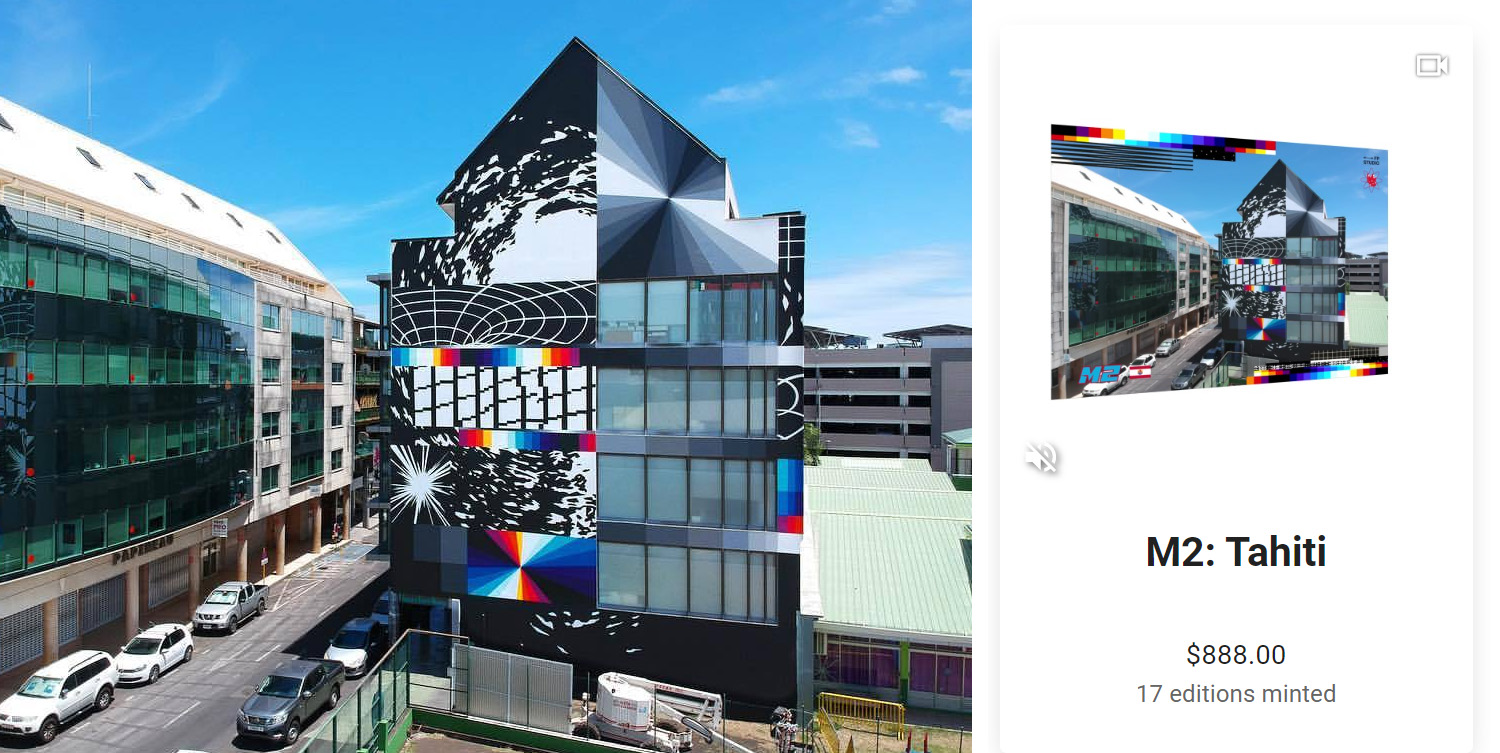
The Graffiti Collection by Felipe Pantone, (Pantone, official website)
Conclusion
All the possibilities of using Blockchain and Artificial Intelligence technology in the field of art that were mentioned in this paper have just emerged in recent years. Exactly this makes them even more important, both for the artists and academics, as well as for art dealers, art curators, and the audience. It is important to explore the options that Blockchain technology and AI are giving us, and to understand them from different points of view. It is for sure that Blockchain and AI stand as relevant factors in enhancing the art world, especially in the field of digital media. We can conclude that technologies should be explored as both a medium and subject of artistic practices, whether they might be conventional, enthusiastic, or critical towards the issues of using technology in art. This exploration can successfully happen only if all the actors within the art world have a voice in how Blockchain and AI might be applied to the field they work in. For that to be possible, we, as academics and/or artists, or art workers, cannot just refuse contemporary technology, saying that it is not relevant to the process of creating and valuing art. We will have to say yes to technology and research the ways it could work for our future ideas.
About the Authors
Marko Suvajdzic, University of Florida Digital Worlds Institute, Gainesville, FL, USA [email protected] Dragana Stojanović, Singidunum University Faculty of Media and Communications, Belgrade, Serbia [email protected] Iryna Kanishcheva, Monochronicle, CEO Public Art Platform, Gainesville, FL, USA [email protected]
Bibliography
[1] T. Adorno & M. Horkheimer, Dialectic of Enlightenment. Stanford University Press, 2002 [2] D. E. Berlyne, “Aestetics and Psychobiology”, Appleton-Century-Crofts, New York, 1971 [3] R. Catlow, “Artists Re:Thinking the Blockchain: Introduction”, in Artists Re:Thinking the Blockchain, eds. Catlow R, Garret M, Jones N. and Skinner S, Torque Editions & Furtherfield, signal 2395, 2017, 21-37 [4] A. Danto, “Symposium: The work of Art, the Artworld”, The Journal of Philosophy Vol. 61, No. 19, American Philosophical Association Eastern Division Sixty-First Annual Meeting (Oct. 15, 1964), pp. 571-584 [5] P. De Filippi, “Plantoid / the Birth of a Blockchain-Based Lifeform”, in Artists Re:Thinking the Blockchain, eds. Catlow R, Garret M, Jones N. and Skinner S, Torque Editions & Furtherfield, signal 2395, 2017, 51-62 [7] G. Dickie, Aesthetics, An Introduction, Pegasus, Cambridge, 1971 [8] FOIA Government https://www.foia.gov/faq.html [9] O. Godbole, “Ether Drops Below $2K, Bitcoin Wilts as China Tells Banks to Cut Off Crypto Transactions”, https://www.coindesk.com/ether-drops-bitcoin-wilts, Retrieved Jun 30 2021 [10] D. J. Haraway, “A manifesto for cyborgs: Science, technology, and socialist feminism in the 1980s” in: Simians, cyborgs, and women: the reinvention of nature. New York: Routledge, New York, 1991, pp. 149–182 [12] MARKET CAP OF NFT WORLDWIDE 2018-2020. Published by Raynor de Best, Mar 16, 2021 - Statista [13] M. McLuhan, Understanding Media: The Extensions of Man, McGraw Hill, New York, 1964 [14] M. McConaghy, G. McMullen, G. Parry, T. McConaghy and D. Holzman, “Visibility and Digital Art: Blockchain as an Ownership Layer on the Internet”, in Strategic Change 26(5), 2017, 461-470 [15] Monochronicle https://monochronicle.com/, retrieved Jun 30 2021 [16] NFT sales in the art segment worldwide in the last 30 days April-June 2021, by type. Published by Statista Research Department, Jun 15, 2021 - Statista [17] R. O’Dwyer, “Limited Edition: Producing artificial scarcity for digital at on the blockchain and its implications for the cultural industries”, Convergence: The International Journal of Research into New Media Technologies, Sage, 2018, 1-21 [19] SALES VOLUME OF NFT IN DIFFERENT SEGMENTS WORLDWIDE 2018-2020. Published by Raynor de Best, Apr 22, 2021 - Statista [20] P. Saxena & S. Srivastava, “An Entrepreneur’s Handbook to Blockchain”, https://appinventiv.com/guide/blockchain-guide-for-entrepreneurs/, retrieved Jun 30 2021 [21] P. Seidler, P. Kolling and M. Hampshire, “terra0 – Can an Augmented Forest Own and Utilize Itself?”, in Artists Re:Thinking the Blockchain, eds. Catlow R, Garret M, Jones N. and Skinner S, Torque Editions & Furtherfield, signal 2395, 2017, 63-72 [22] A. Storey, “How Much Does It Cost to Mint and NFT?”, https://postergrind.com/how-much-does-it-cost-to-mint-an-nft/?utm_source=rss&utm_medium=rss&utm_campaign=how-much-does-it-cost-to-mint-an-nft, Retrieved Jun 30 2021 [23] M. Suvajdžić, D. Stojanović & J. Appelbaum, “Blockchain Art and Blockchain Facilitated Art Economy: Two Ways in Which Art and Blockchain Collide”, 2019 4th Technology Innovation Management and Engineering Science International Conference (TIMES-iCON), DOI: 10.1109/TIMES-iCON47539.2019.9024403, 2019 [25] M. Zeilinger, “Digital Art as ‘Monetized Graphics’: enforcing intellectual property on the blockchain”, in Philos.Technol. DOI 10.1007/sl3347-016-0243-1, published online under the terms of Creative Commons Attribution 4.0 International License, 2016 [26] Felipe Pantone murals https://pant1.tumblr.com/page/10; https://www.felipepantone.com/ [27] Felipe Pantone NFT https://niftygateway.com/collections/felipepantoneopen [28] Raynor de Best, “Market Cap of NFT Worldwide 2018-2020”, Mar 16, 2021. [29] Raynor de Best, “Sales Volume of NFT in Different Segments Worldwide 2018-2020”, Apr 22, 2021. [30] Statista Research Department, “NFT Sales in The Art Segment Worldwide In The Last 30 Days April-June 2021, By Type.” Jun 15, 2021.
0 Comments
No comments yet.